When to neuter: the role of bioassays in decision-making
Author: Helen Evans
Although neutering is one of the most common procedures in UK practice, with around 75% of the canine population neutered,1 its timing is far from straightforward. Differences in physiology, breed risk profiles and individual development make a one-size-fits-all approach inappropriate.
Historically, decisions around timing relied on chronological age or easily observed clinical signs, such as the onset of oestrus in bitches. However, these cues can be misleading, particularly in males where external cues of sexual maturity are often subtle or entirely absent.
Evidence-based
Adding to this complexity is the growing evidence of breed-specific risks. For example, there is an established link between neutering and intervertebral disc herniation (IVDH) in dachshunds. Males neutered before 12 months old, and females neutered either before or after 12 months old, have been shown to be at increased risk of IVDH compared with entire animals.2 Vets must therefore guide owners in making evidence-based decisions regarding whether and when to neuter, based on these breed variations. Yet even within a single breed, significant variation exists.
The HPG axis
Understanding when a dog has reached sexual maturity is central to determining the most appropriate time for neutering. Puberty is a gradual transition involving the brain, endocrine system and reproductive organs. As the hypothalamic–pituitary–gonadal
(HPG) axis matures, hormonal signalling intensifies, activating testicular or ovarian function and initiating the cascade of changes that ultimately lead to reproductive capability.
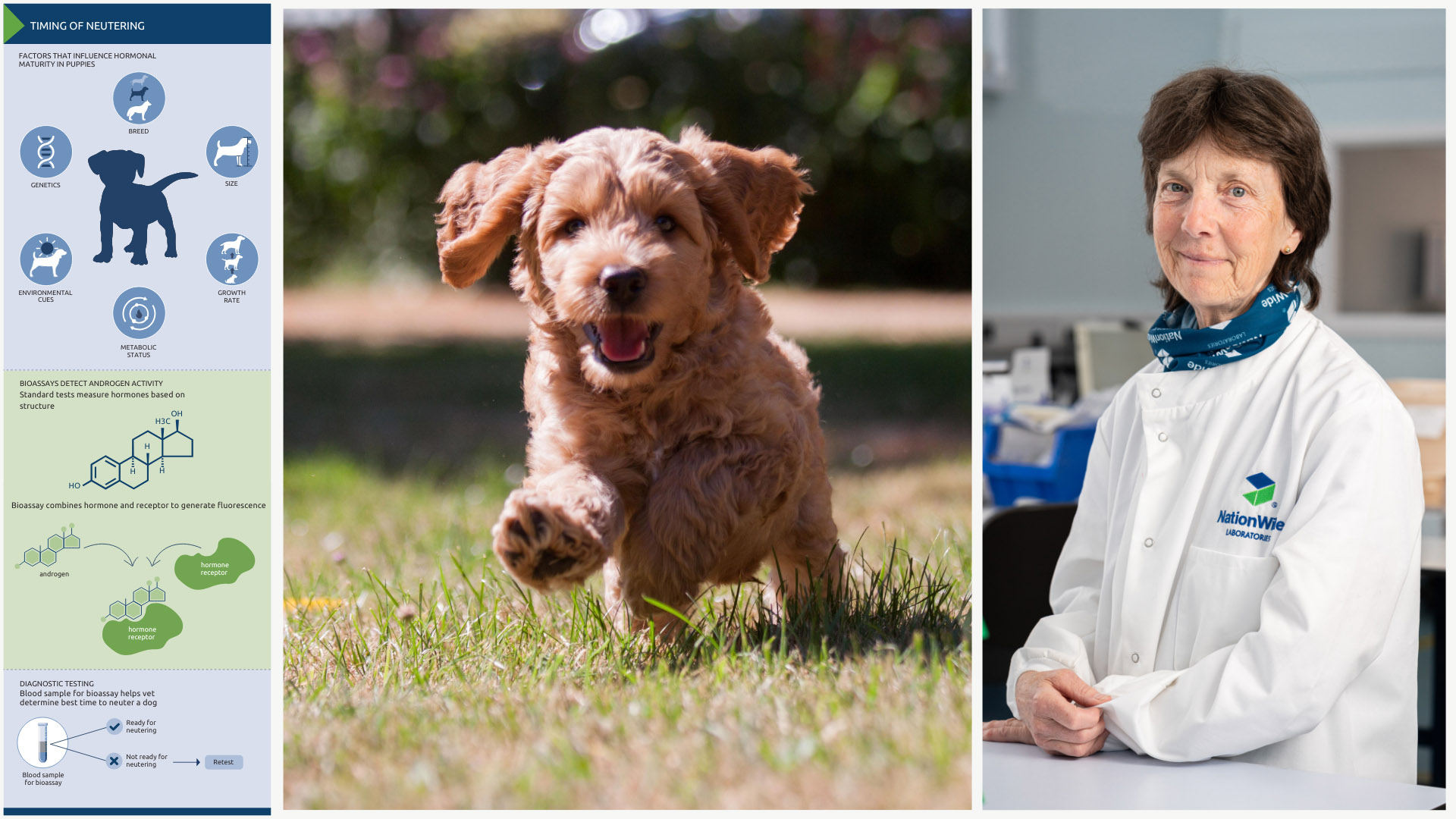
Breed, size, growth rate, metabolic status, genetics and environmental cues all influence when the HPG axis ‘switches on,’ meaning that maturity may be reached at markedly different ages even in individuals of the same breed or type. Understanding this is vital for deciding on the most appropriate time for neutering,3 and highlights the increasing value of laboratory diagnostics capable of assessing maturity on a case-by-case basis.
Biological basis
In male dogs, the transition through puberty is driven by rising androgen activity. Testosterone is produced primarily in the testes under the control of luteinising hormone (LH) and its levels increase steadily as the HPG axis matures. Testosterone is then converted into a stronger androgen, 5α-dihydrotestosterone (DHT), via the enzyme 5α-reductase. DHT binds the androgen receptor with greatest affinity, driving the development of secondary sexual characteristics and the broader physiological changes associated with sexual maturity. In addition to these well-characterised androgens, there are adrenal- and peripheral-sourced androgens such as keto-testosterone, keto-DHT, oxo-testosterone, oxo-DHT that have specific roles in the body and also rise during puberty.
In female dogs, puberty is characterised by increasing ovarian activity and rising concentrations of oestrogens, particularly oestradiol.
A new generation of hormone testing
Traditional hormone assays quantify specific steroid hormones, including testosterone, based on their structure alone. However, they do not account for the wider biological activity of other androgens such as DHT and the keto- and oxo-varieties.
Bioassays such as NeuterReady, for male dogs, can help give a more accurate view of an individual dog’s stage of development, detecting the combined activity of all circulating androgens – not just testosterone. Such tests can also detect androgen bioactivity at low concentrations, distinguishing between juvenile and hormonally mature dogs with high sensitivity (Figure 1). Comparable bioassays assessing oestrogen bioactivity are under development and are likely to offer similar insights into maturity in female dogs.
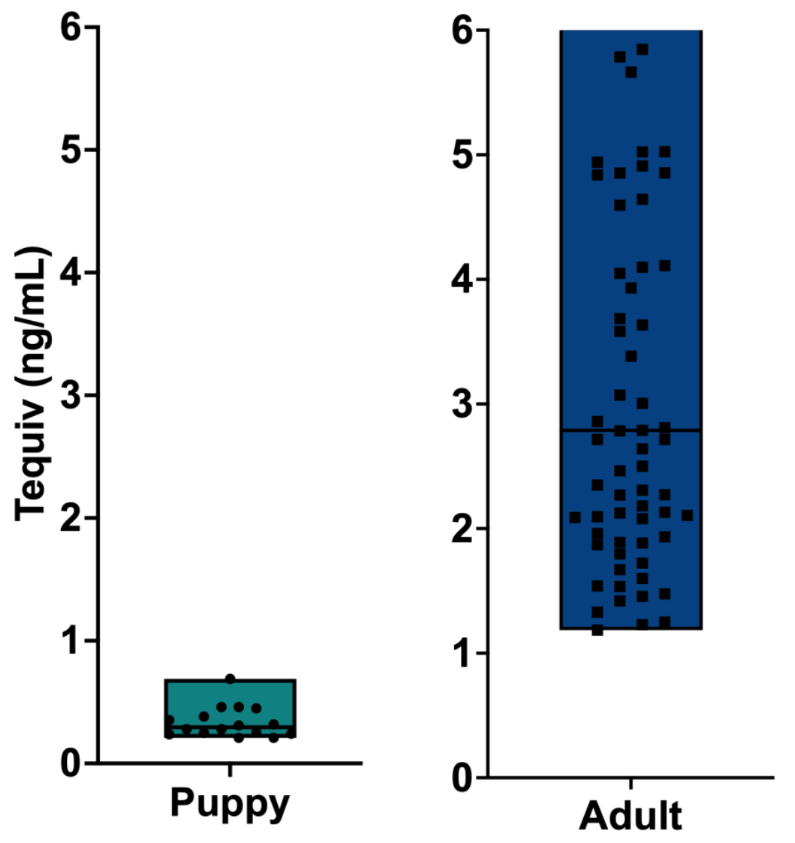
Figure 1. Bioactivity, as testosterone equivalent (Tequiv), of male puppies and adult intact male dogs, including small and large breeds.
For clinicians this represents a significant step forward, enabling timing of neutering to be aligned with physiological rather than age-based milestones. In some young dogs, the test reveals that hormonal maturity has been reached sooner than expected, allowing neutering to proceed with confidence. In others, it indicates that delaying surgery may better support musculoskeletal or behavioural development, for example.
The wider role of reproductive diagnostics
While assessing hormonal maturity is important for neutering decisions, it is only one part of the reproductive picture. A broader diagnostic toolkit allows clinicians to investigate reproductive function with greater accuracy and confidence. (Table 1).
| Test | Clinical use |
| Androgen bioactivity testing | Support decision-making on neuter timing; single blood sample required |
| Testosterone | Screening for presence of testicular tissue |
| hCG stimulation test (testosterone response to hCG challenge) | To identify cryptorchidism or testicular function |
| Oestradiol (E2) | Screening for suspected sertoli cell tumours |
| Progesterone | Help determine the best time for mating |
| Anti-Mullerian Hormone (from ovarian granulosa cells) | Detects presence of ovarian tissue; useful for ovarian remnants or unclear neuter status |
| Oestradiol (E2) | For determining onset of oestrus or the presence of ovarian tissue; for ovarian remnants, GnRH or hCG stimulation test may be necessary |
| GnRH stimulation test (oestradiol pre and 3 hours post iv injection of buserelin) | Detects ovarian remnants |
| hCG stimulation test (oestradiol pre and 90-120 minutes post iv injection of hCG) | Detects ovarian remnants |
| Relaxin (from placental tissue) | Pregnancy diagnosis; blood sample at around 28 days or more post mating |
Table 1. Key reproductive tests and their clinical application
Whether assessing endocrine maturity when planning neutering, investigating suspected ovarian tissue, or confirming neuter status, today’s reproductive tests give clinicians a more complete picture of an individual dog’s physiology, supporting clearer discussions with owners and, ultimately, better long-term outcomes.
About the author
Helen Evans – Laboratory Manager at NationWide Specialist Laboratories
Helen Evans has a strong background in biological sciences and began her career developing assays at St Thomas’ Hospital in London. She later transitioned to veterinary diagnostics, where she has spent over 20 years advancing laboratory testing for companion animals. As co-founder and manager at NationWide Specialist Laboratories, Helen has played a key role in introducing innovative reproductive and endocrine assays, including bioactivity-based tests that support evidence-based decisions on neutering. Her expertise spans endocrinology, biochemistry, and reproductive diagnostics, helping clinicians make informed choices that improve long-term outcomes for pets.
References
1. PDSA animal wellbeing report 2019. https://www.pdsa.org.uk/media/7420/2019-paw-report_downloadable.pdf,
2. Dorn, M. & Seath, I.J. (2018) Neuter status as a risk factor for canine intervertebral disc herniation (IVDH) in dachshunds: a retrospective cohort study. Canine Genet Epidemiol 5, 11 https://doi.org/10.1186/s40575-018-0067-7
3. Hollinshead, F. et al. (2025) Canine Puberty. Vet Clin North Am Small Anim Pract. 55(5):909-921. doi: 10.1016/j.cvsm.2025.05.004. PMID: 40973426.
Original publication: The Veterinary Edge, issue 59, January 2026, pp 30-31
Learn more about the NeuterReady Test, exclusively available in the UK via NationWide Laboratories https://nwlabs.co.uk/neuterready