Tracking Antimicrobial Resistance in companion animals: How diagnostic data supports One Health
By Michelle Pittilla, BSC (Hons), Head of Microbiology at Nationwide Laboratories
Antimicrobial resistance (AMR) in companion animals presents both a clinical and diagnostic challenge. In practice, resistant organisms are most often identified through microbiological testing in clinically affected animals, so the data available to us are largely shaped by submissions from pets already showing signs of disease. While this information is essential for individual case management, it provides only a partial picture of resistance within the wider pet population. As a result, baseline AMR levels in healthy dogs and cats remain poorly understood, limiting our ability to assess trends over time or to understand fully the role of companion animals in the wider epidemiology of resistant bacteria.
In 2025, the Veterinary Medicines Directorate (VMD) announced a pilot study in which faecal samples from healthy dogs and cats will be analysed over 4 years by Scotland’s Rural College (SRUC). The project aims to address important gaps in companion animal AMR surveillance data. Alongside initiatives such as the VetCLIN AMR project at the University of Liverpool which incorporates diagnostic microbiology data into AMR monitoring, the study reflects growing recognition of the role that laboratory data can play in building a more complete understanding of AMR in companion animals.1
The wider context
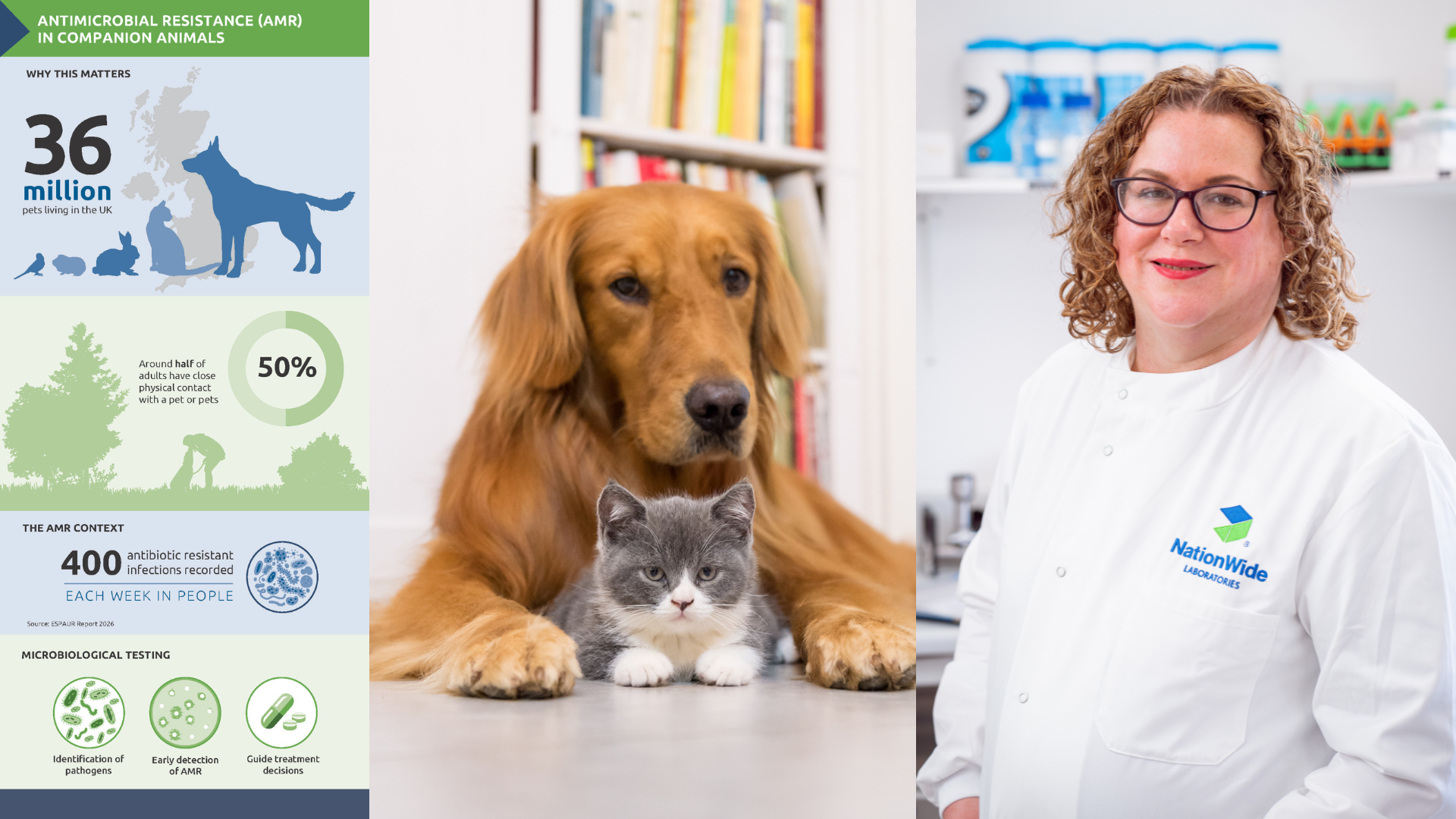
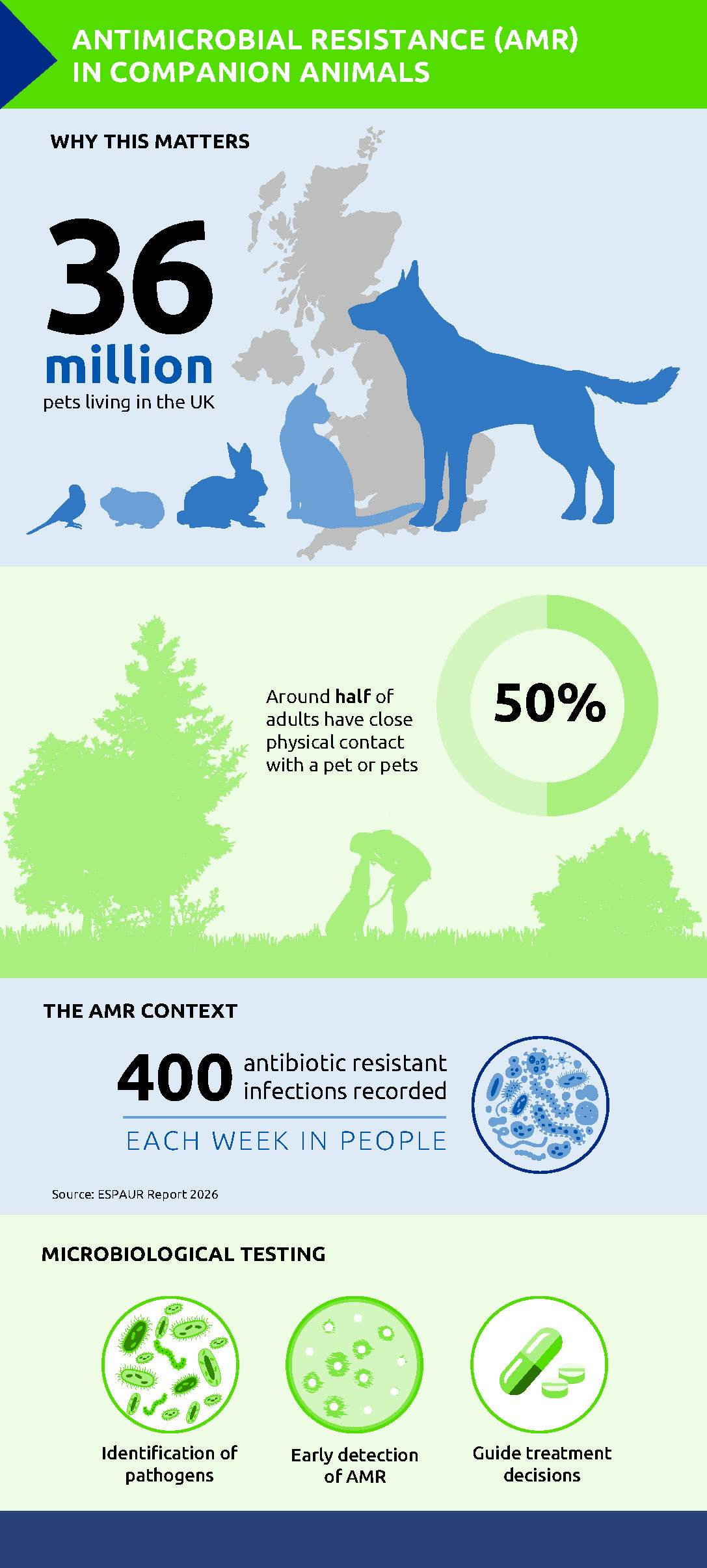
With around 36 million pets living in the UK,2 companion animals are a major part of everyday life. Around half of adults in the UK have one or more pets in their home with whom they have close physical contact, creating opportunities for the zoonotic spread of pathogens, including bacteria that may be resistant to antimicrobials.
At the same time, AMR remains a growing public health concern, with nearly 400 newly reported antibiotic-resistant infections recorded each week in the UK.3 Until now, surveillance for AMR in companion animals has been largely limited to the relatively small number of clinically unwell animals from whom diagnostic samples are submitted. This introduces an unavoidable bias into the data: laboratory findings reflect the organisms present in animals selected for testing, rather than the background prevalence of resistant bacteria in the general pet population. Consequently, there is limited information on baseline resistance levels in healthy dogs and cats, and on the extent to which companion animals may act as silent carriers of resistant organisms..
The role of microbiological testing
Microbiological testing is central to both the diagnosis and surveillance of antimicrobial resistance. In clinical practice, culture and susceptibility testing remain essential tools for identifying bacterial pathogens and guiding treatment decisions in individual cases. Culture of faeces has long been used as a diagnostic tool to identify specific or opportunistic enteropathogenic bacteria. Culture alone can be problematic, as there is lack of standardisation in sampling technique and volume supplied, and aerobic culture methods may not adequately represent the mostly anaerobic intestinal microbiome. More novel techniques such as rapid-PCR allows more accurate identification of the bacteria present in a sample.4
Resistant bacteria can be identified through traditional culture and sensitivity, PCR testing for specific antibiotic resistance genes, selective agar plates (where only resistant bacteria are able to grow) and genomic analysis for specific multi-drug resistant strains.
Relevance for clinicians
Antimicrobial stewardship is already a familiar part of companion animal practice, and for most clinicians, microbiology results are already central to everyday decision-making. However, broader surveillance data remain limited, making it difficult to interpret individual resistance findings in a wider clinical context. The SRUC study may help address that gap.
Surveillance data may support clinicians by:
· Contextualising resistance patterns seen in routine submissions
· Improving understanding of current and emerging AMR trends
· Supporting evidence-based prescribing
· Strengthening stewardship conversations with colleagues and clients
· Helping distinguish isolated findings from broader resistance patterns
· Improving understanding of the wider impact of antimicrobial use, including on the microbiome
The One Health Perspective
AMR is a major global health threat that risks the availability of effective treatment in both animals and humans. Whilst the use of anti-microbials in food producing animals is at its lowest levels since records began, in companion animals there is some way to go both in terms of usage and surveillance.5 Any use of anti-microbials results in selection pressure that increases the risk of AMR, and yet within the companion animal sector, these drugs are often still considered as benign ‘covering’ therapeutic options. Beyond the risk of AMR, the disruption
of the microbiome through antimicrobial use is increasingly understood to have far reaching outcomes on many body systems.
It is now widely accepted that companion animals can act as potential reservoirs of antimicrobial-resistant organisms that can infect humans, often without showing clinical signs themselves. Close contact between pet owners and their animals (or veterinary professionals and their patients) presents multiple opportunities for zoonotic transfer of these resistant pathogens, and so their establishment in human populations. With the UN predicting human AMR related deaths estimated to reach 10 million per year by 2050, this is an issue that needs to be treated with utmost urgency.6
This new study forms part of a multi-agency effort to understand AMR in all species better, and improvement in one species will benefit all living things on this planet.
Take Home Messages
Taken together, these challenges highlight the need for stronger evidence on AMR in companion animals. Diagnostic testing has a central role to play, not only in guiding treatment decisions, but in generating the data needed to support antimicrobial stewardship and detect emerging threats. In this respect, studies involving clinically healthy dogs and cats are a valuable addition to the evidence base. Better diagnostic data should ultimately support better prescribing, better interpretation and a more joined-up One Health approach to AMR.
References
1. UK launches world-first study to assess antibiotic resistance levels in healthy dogs and cats – GOV.UK
2. UK Pet Food Pet Population survey 2026.
3. English surveillance programme for antimicrobial utilisation and resistance (ESPAUR) report – GOV.UK Updated 2026
4. Werner M, Suchodolski JS, Lidbury JA, Steiner JM, Hartmann K, Unterer S. Diagnostic value of fecal cultures in dogs with chronic diarrhea. J Vet Intern Med. 2021;35:199–208. https://doi.org/10.1111/jvim.15982
5. Jarvis, S. (2025), Taking stock on AMR. Veterinary Record, 197: 429-429. https://doi.org/10.1002/vetr.70164
6. Caddey B, Fisher S, Barkema HW, Nobrega DB. 2025. Companions in antimicrobial resistance: examining transmission of common antimicrobial-resistant organisms between people and their dogs, cats, and horses. Clin Microbiol Rev 38:e00146-22. https://doi.org/10.1128/cmr.00146-22
Original publication: The Veterinary Edge, May 2026, pages 40-41
About the author: Michelle Pittilla is head of microbiology at NationWide Laboratories. Michelle graduated from Central Lancashire in Biomedical Science. She is experienced in clinical microbiology and oversees her team daily, working with patient samples and checking the safety of water and environmental samples. She particularly enjoys training new team members and imparting more detailed knowledge onto them to help them better understand their job and the reasons why they do it; encouraging a culture of excellence and client-focused service.